
How Mid-Sized Pharma Is Outsmarting the Giants
The pharmaceutical industry has long been perceived as a game where size dictates success. Blockbuster pipelines, billion-dollar R&D budgets, and expansive sales forces were historically the domain of global giants. Yet a striking shift is underway. Mid-sized pharmaceutical companies those operating with focused pipelines, leaner structures, and sharper strategic intent are increasingly punching well above their weight. Their secret weapon is competitive intelligence (CI): the systematic, ethical, and data-driven collection and analysis of publicly available information to sharpen strategic decision-making.
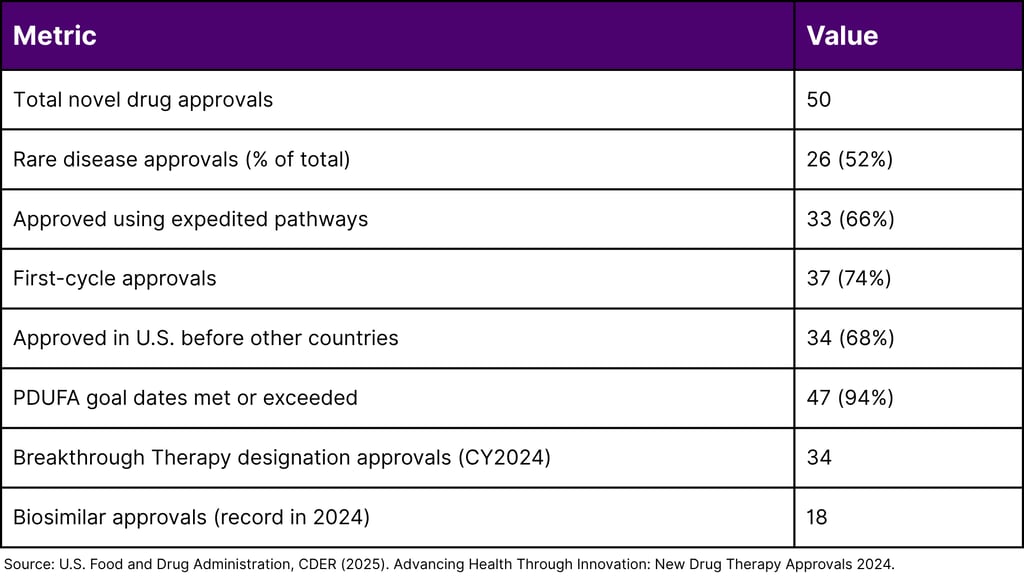
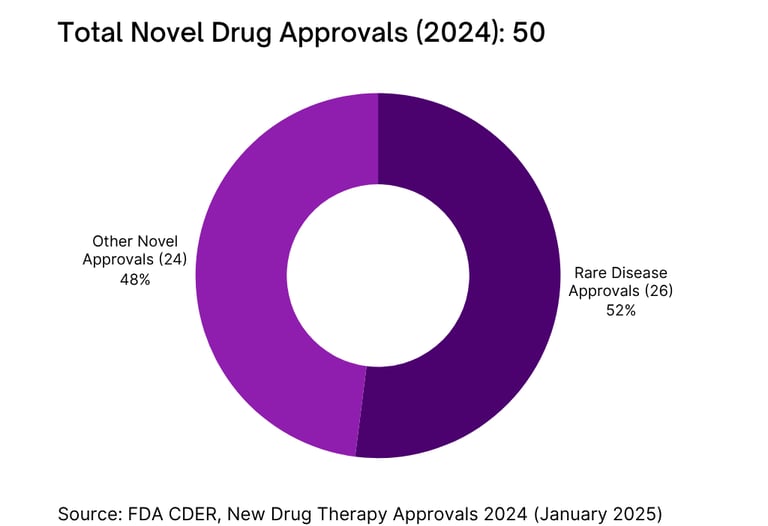
In 2024, the U.S. Food and Drug Administration's Center for Drug Evaluation and Research (CDER) approved 50 novel drugs and 52% of those approvals were for rare diseases (FDA, 2025). This signals a clear trend: the regulatory environment increasingly rewards companies that identify and move quickly into underserved therapeutic niches precisely the kind of intelligence-led strategy that mid-sized firms are mastering. This article explores how they are doing it, what publicly available data sources they are leveraging, and what it means for the future of pharmaceutical competition.
The Competitive Landscape: Size Is No Longer the Only Advantage
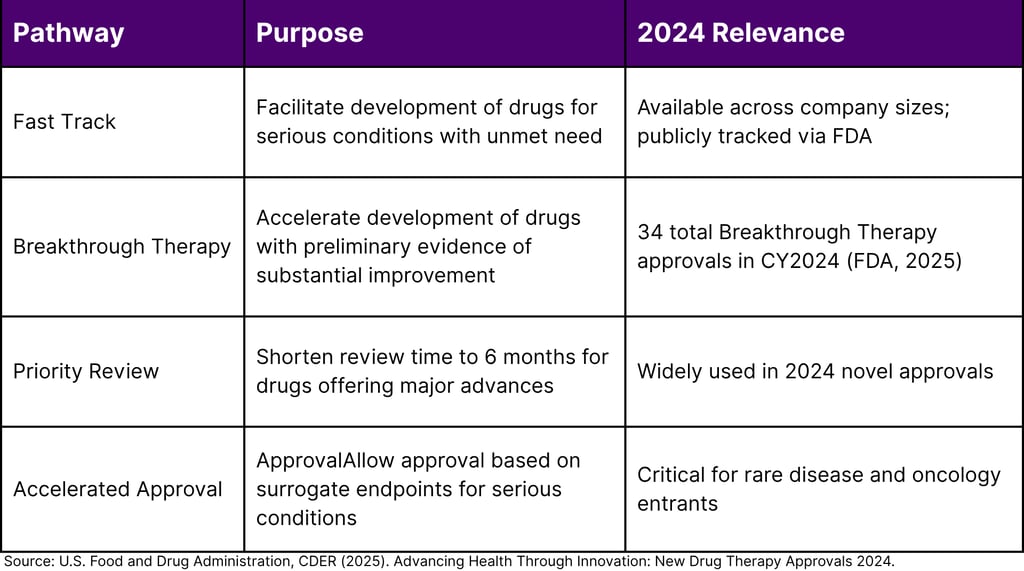
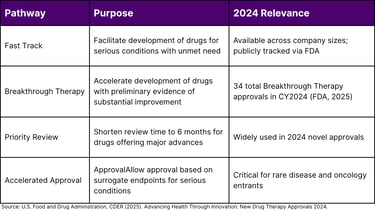
For decades, large pharmaceutical companies dominated drug approvals by virtue of their capital, infrastructure, and established regulatory relationships. However, the structure of pharmaceutical innovation is changing. According to CDER's 2024 New Drug Therapy Approvals report, 66% of the 50 novel drugs approved in 2024 used one or more expedited approval pathways including Fast Track designation, Breakthrough Therapy designation, Priority Review, or Accelerated Approval (FDA, 2025). These pathways, originally designed to democratize access to the approval process for drugs targeting serious conditions, have become a critical equalizer.
Mid-sized companies that understand how to navigate these pathways efficiently gain access to the same regulatory acceleration that once required the political and financial capital of a pharma giant.
Table 1: FDA Expedited Approval Pathways: 2024 Summary
The Role of Public Data in Competitive Intelligence
One of the most underappreciated advantages available to mid-sized pharma companies is the sheer volume of freely available, government-maintained public data. Unlike private intelligence that requires large procurement budgets, these sources are accessible to any organisation with the analytical capacity to interpret them.
Key Government Data Sources Used in Pharma CI
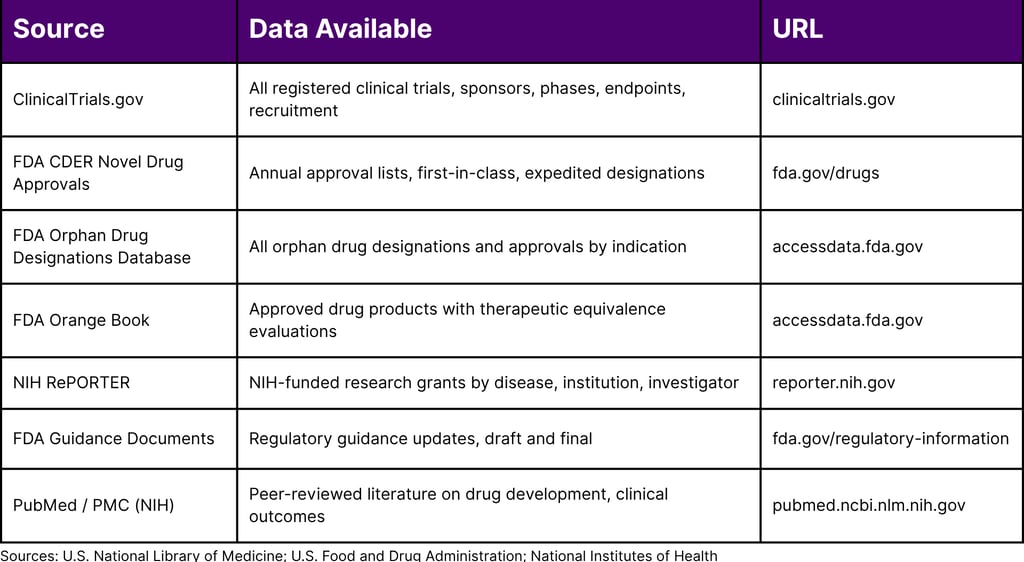
1. ClinicalTrials.gov Maintained by the U.S. National Library of Medicine (NLM) under the National Institutes of Health (NIH), ClinicalTrials.gov is the world's largest registry of clinical trials. As of 2024, the platform surpassed 530,000 total registered studies with the milestone 500,000th study posted during the platform's 25th anniversary year (NLM, 2025). Pharma CI teams routinely scan this database to:
Monitor competitor pipeline progression by phase
Identify therapeutic areas with high trial activity and potential saturation
Detect recruitment slowdowns or trial terminations that may signal competitor setbacks
Understand endpoint design and patient population strategy used by rivals
2. FDA Drug Approval Databases The FDA's publicly accessible databases including the Orange Book, Purple Book, and CDER's novel drug approval records allow mid-sized companies to track approval timelines, first-in-class designations, and therapeutic competition. In 2024, 34 of 50 novel drugs (68%) were approved in the U.S. before any other country (FDA, 2025), giving U.S.-focused CI teams a meaningful first-mover intelligence advantage.
3. FDA Orphan Drug Designation Database The Office of Orphan Products Development (OOPD) maintains a publicly searchable database of all orphan drug designation requests and approvals. In 2024, 26 of 50 novel CDER approvals (52%) were for drugs with orphan drug designation (FDA, 2025). Mid-sized companies use this database to identify which rare disease areas are drawing regulatory and industry attention and crucially, which remain uncontested.
4. FDA AI Guidance and Regulatory Science Publications The FDA has received over 500 submissions with AI components from 2016 to 2023 (FDA, 2025) and published a landmark draft guidance in January 2025 on the use of artificial intelligence in regulatory decision-making. CI-savvy pharma companies monitor these guidance documents to anticipate changes in the regulatory landscape before they are formally enacted.
How Mid-Sized Pharma Companies Turn Public Data Into Strategic Advantage
1. Pipeline Gap Analysis
By mining ClinicalTrials.gov and FDA approval databases, mid-sized companies can identify therapeutic areas where large competitors have few or no active trials. Rare diseases are an especially fertile ground: the FDA's Orphan Drug Act provides sponsors with incentives including 7-year market exclusivity, tax credits for clinical trial costs, and waived application fees (FDA, n.d.) advantages that disproportionately benefit smaller, focused operations.
2. Regulatory Pathway Selection
Choosing the right expedited pathway is not just a regulatory tactic it is a competitive intelligence decision. Mid-sized firms that track the historical use of Breakthrough Therapy designations across therapeutic areas can benchmark their own likelihood of qualification and plan submission timing accordingly. In 2024, there were 34 Breakthrough Therapy designation approvals across all of CDER's novel drug portfolio (FDA, 2025).
3. First-Cycle Approval Monitoring
In 2024, CDER approved 74% of novel drugs on the first review cycle (FDA, 2025). For mid-sized companies, tracking first-cycle approval rates by therapeutic area helps identify submission quality benchmarks, common deficiency patterns, and the standards that regulators expect intelligence that can save years of development time.
Table 2: 2024 CDER Novel Drug Approval Key Statistics
AI and Technology: The New Frontier of Pharma Competitive Intelligence
The integration of artificial intelligence into competitive intelligence is transforming how mid-sized pharma companies process and act on public data. The FDA itself has acknowledged this transition: the agency's 2025 draft guidance on AI in regulatory decision-making reflects the growing role of AI-assisted analysis in drug development submissions (FDA, 2025).
For mid-sized companies, AI tools trained on publicly available FDA documents, clinical trial registries, and patent filings can:
Automatically flag competitor IND submissions and clinical trial phase transitions
Predict regulatory outcomes based on historical approval patterns
Identify unmet medical needs by cross-referencing disease prevalence data from the NIH with current pipeline gaps
The NIH's funding of basic research is a particularly powerful public intelligence source. According to a cross-sectional study published via NIH's PubMed, NIH contributed funding to 354 of 356 drugs (99.4%) approved from 2010 to 2019, totalling $187 billion in basic and applied research (Jackson et al., 2023). This means that mid-sized firms tracking NIH grant allocations all of which are publicly searchable via NIH's Research Portfolio Online Reporting Tools (RePORTER) can anticipate which scientific platforms are nearing translational readiness.
The Rare Disease Opportunity: A Case Study in CI-Driven Strategy
Rare diseases represent the clearest example of how competitive intelligence enables mid-sized pharma to outmanoeuvre larger players. Large companies historically avoided rare diseases due to small patient populations and uncertain revenue projections. Mid-sized companies, unburdened by blockbuster revenue expectations, have moved aggressively into these spaces guided by CI-driven identification of unmet need.
In 2024 alone, the FDA approved treatments for conditions including Niemann-Pick disease type C, WHIM syndrome, Duchenne muscular dystrophy, familial chylomicronemia syndrome, and primary biliary cholangitis several of which had no previously approved treatment (FDA, 2025). Each of these approvals represents a market that a company identified through systematic monitoring of disease registries, orphan drug designation filings, and NIH-funded research all of it publicly available.
Figure 1: Rare Disease Approvals as a Share of Total Novel Drugs (2024)
Building a CI Function Without a Big-Company Budget
The good news for mid-sized pharma is that the most valuable competitive intelligence inputs are free. The challenge is not access it is analytical capacity and systematic process. The following framework outlines how a mid-sized pharma CI team can structure its intelligence operations using only publicly available government data.
Table 3: Publicly Available Government Sources for Pharma Competitive Intelligence
Limitations and Ethical Considerations
Competitive intelligence is only as valuable as the integrity with which it is conducted. Mid-sized pharma companies must ensure their CI activities rely on publicly available, legally obtainable information. Government databases ClinicalTrials.gov, FDA portals, NIH data represent the gold standard of ethical CI sourcing: they are transparent, verifiable, and maintained in the public interest.
CI teams should also remain aware of the limitations of public data. Clinical trial registrations may not capture all strategic intent, and regulatory filings reflect past decisions rather than future direction. Effective CI therefore requires analytical interpretation, not just data collection.
Conclusion
The democratisation of regulatory data, the expansion of expedited approval pathways, and the rare disease opportunity created by the FDA's Orphan Drug Act have collectively tilted the competitive playing field in ways that benefit mid-sized pharmaceutical companies willing to invest in systematic intelligence. In 2024, the evidence from CDER's own approval record shows that agility, niche focus, and regulatory sophistication not simply size and spend are the drivers of pharmaceutical innovation.
Mid-sized pharma companies that build disciplined competitive intelligence practices around publicly available government data are not merely competing with larger players they are increasingly setting the pace.
Frequently Asked Questions (FAQ)
Q1: What is competitive intelligence in the pharmaceutical industry?
Competitive intelligence (CI) in pharma refers to the ethical, systematic collection and analysis of publicly available information including regulatory filings, clinical trial registrations, and government research data to support strategic decision-making in drug development and commercialisation.
Q2: What publicly available government sources are most useful for pharma CI?
The most valuable sources include ClinicalTrials.gov (maintained by the NIH's National Library of Medicine), FDA drug approval databases (including the Orange Book and CDER's novel drug lists), the FDA's Orphan Drug Designations database, NIH's RePORTER grant database, and FDA regulatory guidance documents.
Q3: How did the FDA's 2024 novel drug approval statistics benefit mid-sized companies?
In 2024, 52% of CDER's 50 novel drug approvals were for rare diseases, and 66% used at least one expedited pathway (FDA, 2025). These statistics indicate that the regulatory environment strongly supports focused, niche-oriented strategies precisely the approach favoured by mid-sized firms.
Q4: What is the significance of ClinicalTrials.gov for competitive intelligence?
ClinicalTrials.gov surpassed 530,000 registered studies in 2024 (NLM, 2025). It is the world's largest public repository of clinical trial information and allows pharma CI teams to monitor competitor pipeline progression, endpoint strategy, and recruitment patterns in near real-time.
Q5: Can mid-sized pharma companies realistically compete with larger players using CI alone?
CI does not replace capital or infrastructure, but it significantly amplifies strategic efficiency. By identifying pipeline gaps, uncontested therapeutic niches, and regulatory pathway opportunities ahead of larger competitors, mid-sized companies can allocate limited resources with greater precision often achieving faster time-to-approval in targeted areas.
Q6: How is AI changing competitive intelligence in pharma?
The FDA received over 500 drug development submissions with AI components from 2016 to 2023 (FDA, 2025). AI tools are increasingly being used to process large volumes of public regulatory and clinical data, enabling mid-sized pharma companies to generate CI insights at a scale and speed previously unavailable to them.
References
Jackson, G., Galkina Cleary, E., & Ledley, F. D. (2023). Comparison of research spending on new drug approvals by the National Institutes of Health vs the pharmaceutical industry, 2010–2019. JAMA Network Open, 6(4), e2310822.
U.S. Food and Drug Administration, Center for Drug Evaluation and Research. (2025, January). Advancing health through innovation: New drug therapy approvals 2024.
U.S. Food and Drug Administration. (2025, January). Considerations for the use of artificial intelligence to support regulatory decision-making for drug and biological products [Draft guidance].
U.S. Food and Drug Administration. (2025, February). CDER Breakthrough Therapy designation approvals, calendar year 2024.
U.S. Food and Drug Administration. (2024). CDER brings many safe and effective therapies to patients and consumers in 2024 [FDA Voices].
U.S. Food and Drug Administration. (2025). Artificial intelligence for drug development.
U.S. Food and Drug Administration. (n.d.). Designating an orphan product: Drugs and biological products.
U.S. National Library of Medicine. (2025, April 2). ClinicalTrials.gov: A 25-year journey to a half-million registered studies [NLM Musings from the Mezzanine].
Navigation
© 2026 FyreIgnis Market Research. All rights reserved.
Legal
info@fyreignismarketresearch.com
India