Mapping the Competitive Moat


In pharmaceutical development, the race for competitive advantage rarely begins at the clinic. By the time a competitor's drug enters Phase I trials, the strategic window for early repositioning has already narrowed significantly. Yet most organisations direct their competitive intelligence (CI) efforts toward publicly registered clinical data a stage where pre-clinical groundwork has already determined much of the trajectory.
The most consequential intelligence happens before a molecule ever touches a human subject. Understanding how to read the signals of pre-clinical pipeline activity from patent filings to government grant databases equips strategy and R&D teams to make smarter, faster decisions about their own development priorities.
This article outlines best practices for conducting under-the-radar competitive intelligence during the pre-clinical phase, drawing exclusively on publicly available government data sources.
Why the Pre-Clinical Phase Is the Competitive Blind Spot
The drug development pipeline is long, expensive, and largely invisible in its earliest stages. According to the U.S. Food and Drug Administration (FDA), the typical drug development journey spans 10 to 15 years from initial discovery to approval, with pre-clinical research consuming a substantial share of that time before any public disclosure is required.
The FDA's Center for Drug Evaluation and Research (CDER) receives approximately 1,500 new Investigational New Drug (IND) applications per year but these submissions represent only the endpoint of years of pre-clinical work that occurred largely outside public view. By the time an IND is filed, competitors may have already locked in key IP positions, locked up manufacturing partners, or secured specialist academic collaborators.
Table 1: FDA Drug Development Timeline Key Milestones
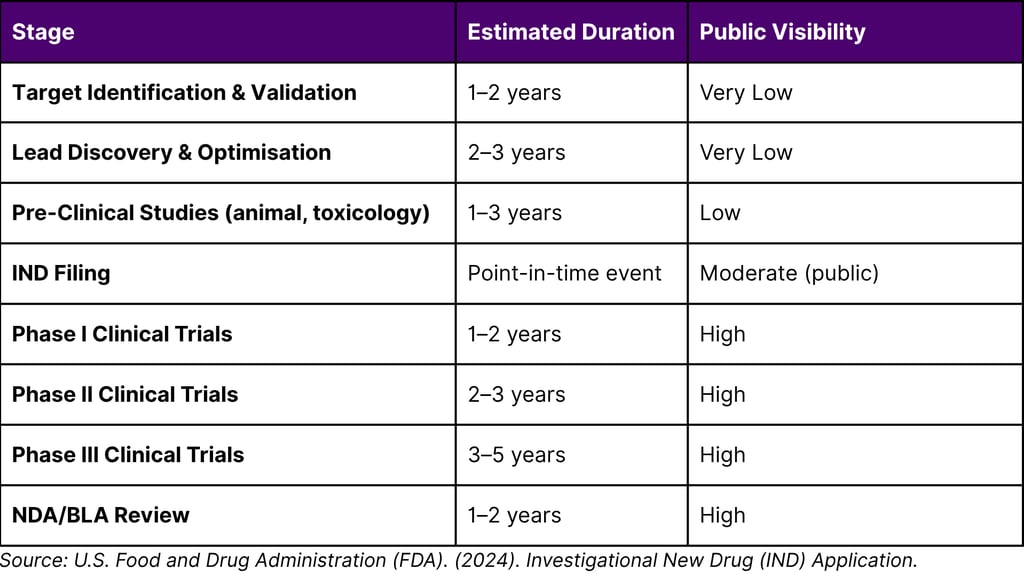
Understanding the competitive landscape at the pre-clinical stage requires intelligence practitioners to work backwards from weak signals patent filings, government grant awards, academic publications, and regulatory interactions rather than waiting for clinical registration.
The Information Architecture of Pre-Clinical Intelligence
1. USPTO Patent Filings: The Earliest Competitive Signal
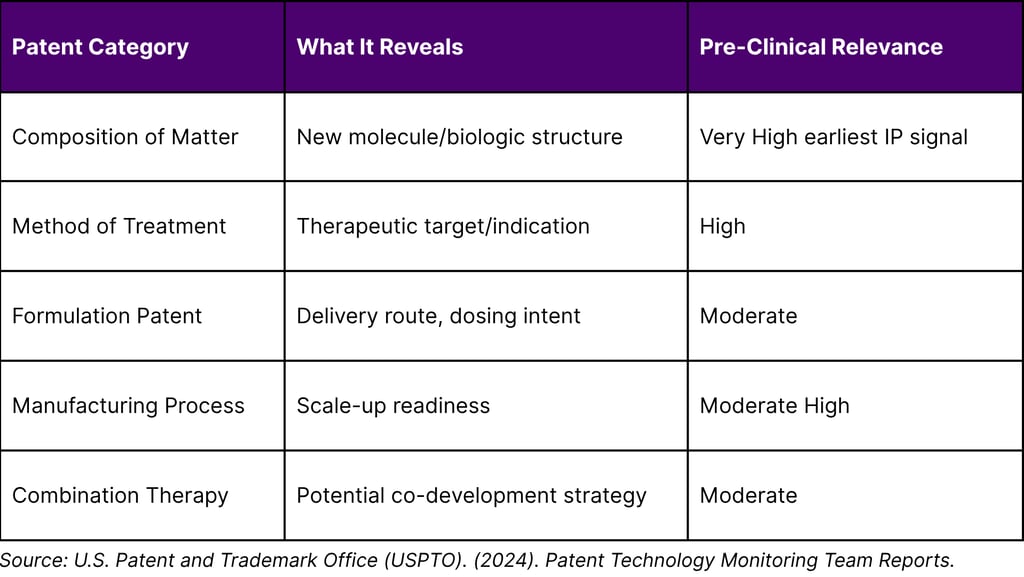
Patent applications are among the most powerful and underutilised sources of pre-clinical competitive intelligence. Under US patent law, pharmaceutical companies typically file patent applications very early in the discovery process to protect novel chemical entities (NCEs), biological targets, and synthetic processes. This filing generally occurs 3 to 5 years before any IND submission and thus many years before clinical trial registration.
The United States Patent and Trademark Office (USPTO) makes patent applications publicly accessible 18 months after filing. Monitoring new filings in specific therapeutic classes, chemical series, or biological target spaces can reveal competitor pipeline activity long before clinical disclosure.
Key Government Database: USPTO Patent Full-Text and Image Database (PatFT) — https://patft.uspto.gov/
What to track:
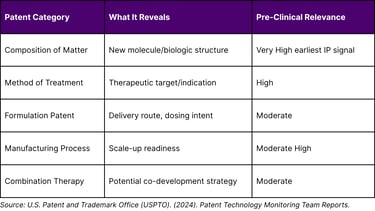
New composition-of-matter patents covering novel chemical series or biologics
Method-of-treatment claims covering previously unprotected indications
Manufacturing and formulation patents indicating scaling ambitions
Continuation filings that suggest active asset development rather than portfolio maintenance
Table 2: Categories of Pharmaceutical Patents and Their Intelligence Value
2. NIH RePORTER: Mapping the Academic Pre-Clinical Frontier
A substantial proportion of pre-clinical drug research originates within academic laboratories, funded by the National Institutes of Health (NIH). NIH's Research Portfolio Online Reporting Tools (RePORTER) a publicly searchable database catalogues every NIH-funded research project, including investigators, publications, and associated patents. This resource offers an extraordinary window into emerging science that is often years away from any commercial announcement.
Government Database: NIH RePORTER — https://reporter.nih.gov/
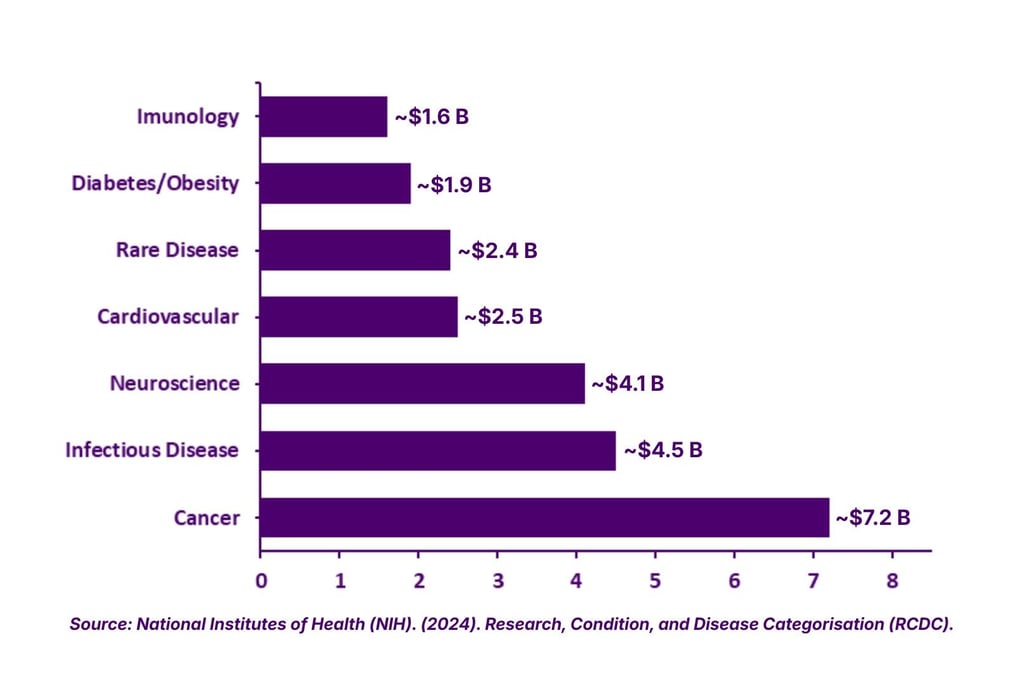
The NIH funds research across a broad array of therapeutic categories. The RCDC (Research, Condition, and Disease Categorisation) system at NIH categorises funded projects by disease area and provides annual spending estimates a proxy for where academic pre-clinical activity is concentrated.
How to use NIH RePORTER for CI:
Search by therapeutic keyword (e.g., "KRAS inhibitor," "GLP-1 receptor," "tau pathology") to identify active academic programmes
Track which investigators are publishing pre-clinical findings and receiving escalating NIH funding
Monitor institutional technology transfer offices of universities receiving large grants these often precede licensing deals with pharmaceutical companies
Set alerts for new grants in your therapeutic area of focus
Figure 1: Indicative NIH Categorical Spending by Disease Area (FY2024 Estimates)
3. ClinicalTrials.gov: Reading Forward from Phase I Registrations
While ClinicalTrials.gov primarily documents clinical-stage activity, it offers a powerful retroactive lens into pre-clinical work. Sponsored by the U.S. National Library of Medicine (NLM), the registry contains information on hundreds of thousands of studies worldwide.
Government Database: ClinicalTrials.gov — https://clinicaltrials.gov/
A newly registered Phase I trial is the public disclosure of a decision made years earlier in the pre-clinical lab. By tracking Phase I registrations systematically and associating them back to their originating patent filings and NIH grants, intelligence teams can build a reverse-engineering timeline that reveals where competitors were investing their pre-clinical resources 3 to 5 years prior.
Table 3: Pharmaceutical Pipeline Phase Distribution — Selected Therapeutic Areas (as of January 2024)
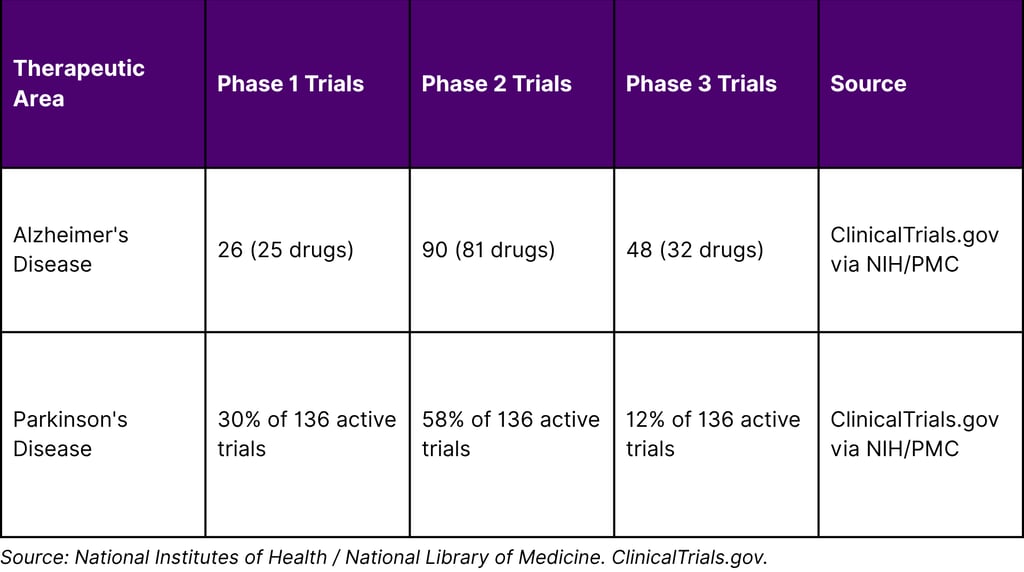
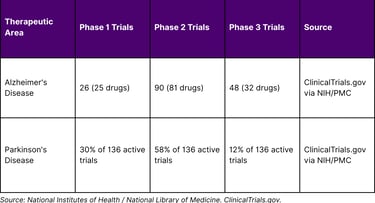
The imbalance between Phase 1/2 and Phase 3 activity in many therapeutic areas also signals where the pre-clinical pipeline is most active. A large Phase 1 cohort today predicts significant Phase 2 competition in 2 to 3 years valuable foresight for portfolio planning.
4. FDA Regulatory Interactions: The Pre-IND Footprint
Before submitting a formal IND, many sponsors engage the FDA through pre-IND meetings and the INTERACT programme (for biologics). While the content of these consultations is confidential, their occurrence is sometimes disclosed in company communications, investor filings, and conference presentations. Additionally, FDA's public-facing records and meeting announcements provide indirect signals.
The FDA's IND Activity Reports, published annually, track the volume and type of IND submissions by fiscal year offering a macro-level view of which therapeutic categories are experiencing pre-clinical acceleration.
Key Government Resource: FDA IND Activity Reports — https://www.fda.gov/drugs/drug-and-biologic-approval-and-ind-activity-reports/ind-activity
What the IND Activity Data Tells You:
Annual volume of new IND submissions by category (commercial vs. research)
Breakthrough Therapy Designation (BTD) requests an early indicator of highly promising pre-clinical candidates
Fast Track Designation requests, which often accompany strong pre-clinical packages
Expanded access requests, which can signal rare disease pre-clinical activity
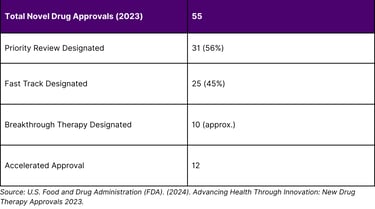
Figure 2: FDA Expedited Programme Designations — 2023 Novel Approvals
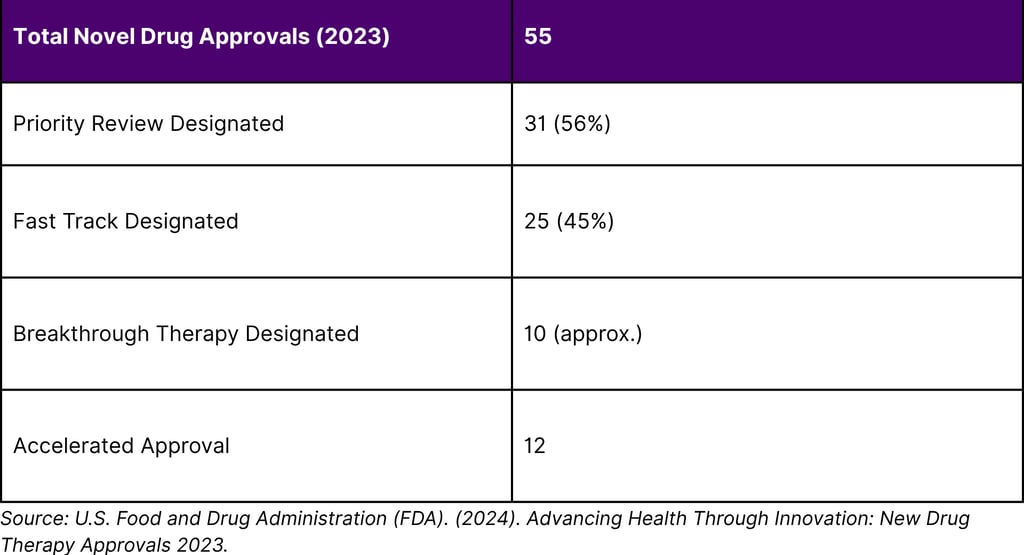
Tracking Breakthrough Therapy Designation (BTD) requests even before they are granted is one of the strongest leading indicators of a competitor's pre-clinical confidence. Companies rarely request BTD without compelling pre-clinical data in hand.
Building a Systematic Pre-Clinical CI Framework
Conducting effective pre-clinical CI requires a structured, repeatable process. The following framework integrates government data sources into a coherent intelligence workflow.
Step 1 — Define Your Intelligence Requirements Identify the specific therapeutic areas, molecular targets, or technology platforms where competitive intelligence is most strategically valuable. Prioritise based on your own pipeline assets and near-term business decisions.
Step 2 — Establish Patent Monitoring Routines Set up automated alerts on USPTO for new patent publications within defined technology classifications (CPC codes) relevant to your focus areas. Review new filings weekly or biweekly. Flag composition-of-matter filings from known competitors or academic institutions in your space.
Step 3 — Track NIH Funding Flows Use NIH RePORTER to identify academic groups actively funded in your target therapeutic areas. Note escalating grant awards, new programme project grants (P01), and SBIR/STTR awards to small biotechnology companies the latter often signal early-stage companies building pre-clinical assets with commercial intent.
Step 4 — Monitor ClinicalTrials.gov Prospectively Set up monitoring for new Phase I registrations in your therapeutic area. When a new trial is registered, trace it back through patents and publications to reconstruct the competitor's pre-clinical history and timeline.
Step 5 — Track FDA Designation Activity Monitor FDA's public announcements on Breakthrough Therapy Designation grants and Fast Track Designations. Cross-reference these with patent filings and NIH grants to triangulate the strength and stage of competitor pre-clinical programmes.
Step 6 — Synthesise and Disseminate Regularly synthesise findings into structured competitive landscape reports. Distinguish confirmed intelligence from inferred signals. Share with R&D, strategy, and business development teams on a defined cadence.
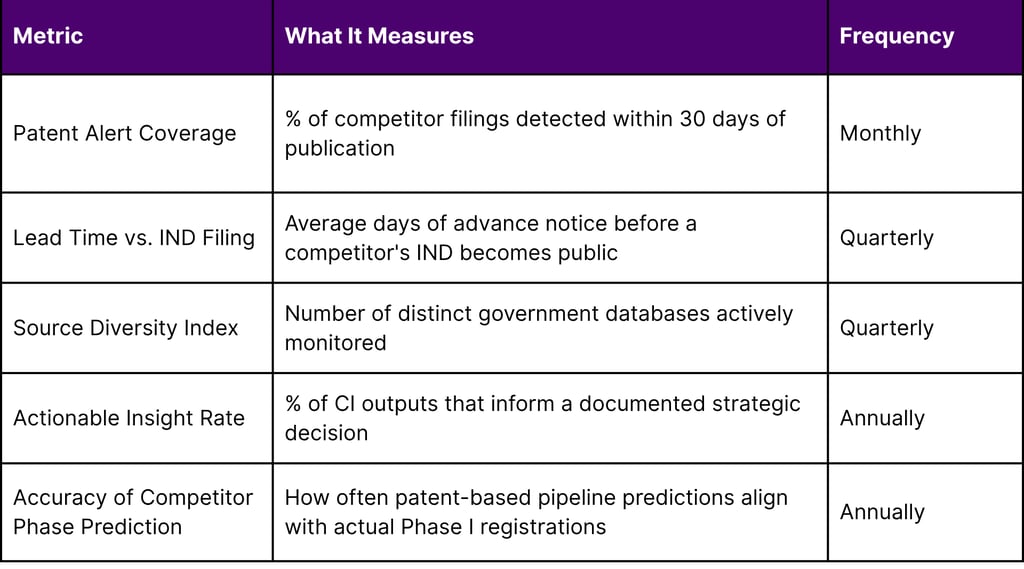
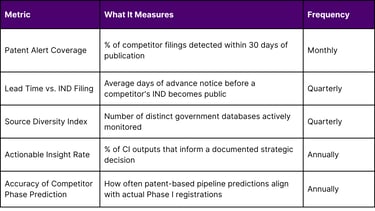
Key Success Metrics for Pre-Clinical CI
Table 4: Measuring the Effectiveness of Your Pre-Clinical CI Programme
Common Pitfalls in Pre-Clinical Competitive Intelligence
Overreliance on Clinical Data Alone: Monitoring only ClinicalTrials.gov means the competitive signal arrives too late. By Phase I, competitors have already secured key IP and locked in development strategies.
Ignoring Academic Pipelines: Approximately 31.8% of pre-clinical drug candidates originate in academic settings (NIH/PMC, 2018). Overlooking academic institutions means missing a large portion of the emerging competitive landscape.
Point-in-Time Analysis: Pre-clinical CI requires continuous monitoring, not periodic snapshots. Patent filings, grant awards, and pre-IND activity are continuous streams that require structured, ongoing attention.
Conflating Activity with Intent: Not every patent filing becomes a development programme. Cross-referencing multiple signals patents, grants, publications, regulatory interactions is essential to distinguish genuine pipeline investments from opportunistic IP filings.
Conclusion
The competitive moat in pharmaceutical development is built largely in the years before any clinical trial is registered. For organisations that wait for public clinical disclosures before acting, the window for strategic response is already closing. Systematic pre-clinical competitive intelligence anchored in publicly available government databases including the USPTO, NIH RePORTER, ClinicalTrials.gov, and FDA IND Activity Reports provides the analytical foundation to act earlier, smarter, and with greater precision.
As the FDA continues to receive approximately 1,500 new IND applications annually, and as expedited pathways like Breakthrough Therapy Designation become the norm for innovative therapies (57% of applications in 2024 carried at least one expedited designation), the pace of the pre-clinical competitive environment will only accelerate. The organisations that invest in structured pre-clinical CI today will be the ones shaping rather than reacting to the competitive landscape of tomorrow.
Frequently Asked Questions (FAQ)
Q1: What is the most accessible starting point for pre-clinical competitive intelligence?
The NIH RePORTER database (https://reporter.nih.gov/) is one of the most accessible starting points because it is freely available, comprehensive, and updated regularly. It allows users to search by disease area, investigator, institution, and keyword, providing direct visibility into government-funded pre-clinical research.
Q2: Can I track a specific competitor's pre-clinical pipeline using public sources?
Yes, to a significant extent. By combining USPTO patent searches (filtering by assignee), NIH RePORTER searches (filtering by institution or investigator linked to a company), and ClinicalTrials.gov sponsor monitoring, it is possible to construct a reasonably detailed map of a competitor's pre-clinical activity over time.
Q3: How early can patent monitoring provide competitive signals?
Patent applications are published 18 months after the earliest filing date under US law. Given that pharmaceutical companies often file patents at the lead optimisation stage typically 3 to 5 years before an IND is submitted patent monitoring can provide competitive signals 4 to 6 years before a competitor's drug enters any public clinical registry.
Q4: What is the difference between pre-IND and IND activity from an intelligence perspective?
Pre-IND meetings (including FDA's INTERACT programme) are confidential consultations between sponsors and the FDA. However, their occurrence is sometimes inferred from public disclosures, conference presentations, and investor communications. The IND itself, once submitted, triggers a 30-day FDA review clock and is not publicly disclosed in its contents but its existence may become known through company announcements.
Q5: How reliable is ClinicalTrials.gov as a reverse-engineering tool for pre-clinical intelligence?
ClinicalTrials.gov is highly reliable for identifying the moment a pre-clinical programme transitioned to clinical testing. However, some programmes are registered late or incompletely. It is most powerful when used in combination with patent and NIH grant data to reconstruct a competitor's full pre-clinical timeline.
Q6: How do FDA Breakthrough Therapy Designations factor into pre-clinical CI?
Breakthrough Therapy Designations (BTDs) are often requested when a sponsor has compelling pre-clinical or early clinical data suggesting substantial improvement over existing therapies. Monitoring BTD grant announcements (published on the FDA website) therefore provides a leading indicator of programmes that have cleared strong pre-clinical hurdles. In 2023, drugs with BTD were among the most significant novel approvals of the year.
Q7: Is this type of intelligence gathering legal and ethical?
Yes. All sources described in this article are publicly available government databases. The US government mandates transparency in research funding (NIH), patent filings (USPTO), clinical trial registration (ClinicalTrials.gov), and drug approval activity (FDA) precisely to enable informed decision-making by all stakeholders. Using these resources for competitive intelligence is entirely lawful and consistent with standard industry practice.
References
U.S. Food and Drug Administration. (2024). Investigational New Drug (IND) Application.
U.S. Food and Drug Administration. (2024). Drug and Biologic Approval and IND Activity Reports.
U.S. Food and Drug Administration. (2024). IND Activity Reports.
U.S. Food and Drug Administration. (2024). Novel Drug Approvals at FDA.
U.S. Food and Drug Administration. (2024). Advancing Health Through Innovation: New Drug Therapy Approvals 2023 [PDF].
National Institutes of Health. (2024). Research, Condition, and Disease Categorisation (RCDC) — Categorical Spending.
National Institutes of Health. (2024). RePORT Expenditures and Results (RePORTER).
National Institutes of Health, National Library of Medicine. (2024).
U.S. Patent and Trademark Office. (2024). Patent Technology Monitoring Team (PTMT) Reports.
National Institute of Allergy and Infectious Diseases (NIAID). (2024). Find Funded Projects and More Using NIH Databases.
Navigation
© 2026 FyreIgnis Market Research. All rights reserved.
Legal
info@fyreignismarketresearch.com
India